


by Will Williamson on 3 Dec 2025, 14:49:11

Every business owner wants more sales. But without a steady flow of qualified leads, growth quickly becomes unpredictable. Many SMEs end up relying too heavily on a handful of clients, which makes planning for the future difficult. Lead generation solves this problem by creating a consistent flow of opportunities, giving you the confidence to grow with stability.

The good news is you no longer have to depend on cold calls or word of mouth alone. Today, there are proven digital tools that attract the right people, capture their details, and nurture them until they’re ready to buy. From prospecting platforms and data enrichment tools to landing page builders, chatbots, CRMs, and marketing automation, the right mix will save time, improve follow-up, and ensure no opportunity slips through the net.
In this article, we’ll introduce some of the best lead generation tools, explain how they work, and help you choose the right ones for your business. The aim isn’t to add complexity, but to give you a clear, repeatable system for generating leads and converting them into customers.
Why Lead Generation Matters
For SMEs, lead generation is the foundation of growth. With limited time and budget, you can’t afford wasted effort. The right approach allows you to compete with larger companies, fill your pipeline, and turn more prospects into paying customers.
Here’s why you should make it a priority:
- It Identifies The Right Opportunities – Focus your energy on prospects who have a genuine interest in what you offer.
- It Improves Conversion Rates – Targeted leads are far more likely to become loyal customers.
- It Gives You Valuable Insight – By understanding who is engaging with you, you can shape your marketing and sales strategy more effectively.
- It Helps You Adapt – Buying behaviours change all the time, and consistent lead generation helps you stay ahead of your market.
It also builds credibility. When you’re visible, helpful, and present across multiple channels, potential customers begin to trust you long before they speak to you.
Start With Strategy Before Tools
Before you invest in any lead generation tool, you need a clear strategy. The best software in the world won’t deliver results if you haven’t decided who you’re targeting, what you want to achieve, and how you’ll follow up.
That’s why we always start with strategy. In our Proven 6-Step System, strategy and planning are step one. It gives you the foundations you need to make sure every tool you use works together to generate qualified leads and consistent sales.
Here’s what to focus on first:
- Set Clear Goals – Do you want to generate more enquiries, improve the quality of leads, or expand into a new market?
- Define Your Ideal Customers – Create buyer personas so you know exactly who you’re trying to attract and what problems you solve for them.
- Research Competitors – See where you can stand out and what gaps you can fill.
- Clarify Your Value Proposition – Make sure your prospects understand why they should choose you.
- Align Marketing and Sales – Ensure your sales team can follow up quickly and consistently with every lead you generate.
A good strategy isn’t a one-off exercise. Review and refine it regularly using your performance data so you can adapt to market changes and keep your tools working effectively.
With the right foundation, tools stop being “shiny objects” and become part of a complete system that drives growth.
38 Essential Lead Generation Tools
There are dozens of tools available that promise to help you find, capture, and convert leads. The challenge is knowing which ones are right for your business. Below, we’ve grouped some of the best-known lead generation and sales tools into categories, explained what they do, and highlighted when they’re most useful.
Contact Discovery & Data Enrichment
These tools help you build contact lists and enrich your existing data with accurate emails, phone numbers, and firmographic details.
Hunter.io
Find and verify professional email addresses by domain or individual. Bulk search and validation reduce bounce rates.
Good for: SMEs starting outbound campaigns, cleaning up lists, and ensuring emails reach inboxes.
ZoomInfo
A premium B2B contact database with deep company, industry, and intent data.
Good for: Larger B2B teams or businesses investing in account-based marketing.
Lusha
A Chrome extension and platform for finding direct dials and emails from LinkedIn profiles and company sites.
Good for: Sales reps who need fast, verified contact info.
Clearbit
Adds enrichment to your existing contacts, such as company size, sector, and funding. Integrates with CRMs and marketing platforms.
Good for: Improving targeting and segmentation with richer data.
Cognism
Provides GDPR-compliant prospect data, with mobile numbers and intent signals.
Good for: European and UK B2B firms needing compliant outbound data.
Apollo.io
Database plus outbound engagement platform, offering contacts, email sequences, and analytics in one.
Good for: SMEs wanting an all-in-one sales prospecting solution.
Sales.Rocks
Prospecting tool with enrichment, segmentation, and bulk email/SMS features.
Good for: Outbound teams that want enriched data plus integrated outreach.
Kaspr
Extracts B2B contact data directly from LinkedIn.
Good for: Sales reps doing heavy LinkedIn prospecting who want verified contact info quickly.
Sales Prospecting & Outreach Automation
These platforms automate cold email, follow-ups, and multichannel outreach to make sure no lead is forgotten.
Instantly.ai
AI-powered cold email and outreach platform with inbox rotation for scale.
Good for: Businesses sending high volumes of cold emails while avoiding spam issues.
LeadIQ
Helps capture and enrich contact details from LinkedIn, with automatic CRM syncing.
Good for: SDRs and outbound teams building lead lists quickly.
Outreach
Enterprise-level sales engagement platform for email sequences, call tracking, and task automation.
Good for: Larger sales teams running multi-step, multi-channel outreach at scale.
Reply.io
Automates outreach across email, LinkedIn, and calls, with personalisation features.
Good for: SMEs wanting affordable multichannel sales automation.
FindThatLead
Find emails and automate cold campaigns, with a Chrome extension for quick prospecting.
Good for: Startups and small teams experimenting with outbound.
CRM & Sales Management
CRMs organise your leads, track deals, and integrate marketing and sales activity.
HubSpot
Free CRM with scalable marketing, sales, and service tools. Integrates landing pages, automation, and analytics.
Good for: SMEs that want everything in one place — from website to sales pipeline.
Zoho CRM
Flexible CRM with affordable pricing and a wide feature set.
Good for: Businesses looking for a cost-effective alternative to HubSpot or Salesforce.
Salesforce
The industry-leading CRM is highly customisable but complex to implement.
Good for: Larger organisations with multi-layered sales processes.
Pipedrive
Pipeline-focused CRM with an easy visual interface.
Good for: SMEs wanting a simple, user-friendly CRM.
Zendesk Sell
CRM focused on sales productivity with built-in communication tools.
Good for: Sales teams already using Zendesk for support.
ConvergeHub
All-in-one CRM for sales, marketing, service, and billing.
Good for: SMEs who want multiple functions in one platform.
Website & Conversion Optimisation
These tools help you capture leads from your website with forms, landing pages, and pop-ups.
OptinMonster
Create pop-ups, overlays, and lead forms with advanced targeting.
Good for: Increasing conversions from existing web traffic.
Leadpages
Landing page builder with templates and integrations.
Good for: Quick campaign-specific pages without developer help.
Instapage
Advanced landing page builder with personalisation and testing.
Good for: Businesses investing in paid ads who need high-converting landing pages.
Unbounce
Landing page and pop-up builder with strong A/B testing features.
Good for: Marketers who want to continually optimise conversions.
OptimizePress
WordPress plugin for landing pages and membership sites.
Good for: SMEs running on WordPress who need easy lead capture.
Carrd
Simple one-page site builder for lightweight campaigns.
Good for: Startups and micro-businesses testing offers quickly.
Sumo
Free suite of email capture tools for pop-ups and scroll boxes.
Good for: Budget-conscious businesses looking for basic on-site capture.
Chat, Scheduling & Engagement
These tools make it easier for prospects to interact with you, book calls, or get answers fast.
Drift
Conversational marketing platform with live chat, chatbots, and meeting booking.
Good for: Companies with high-value leads who need fast, personalised engagement.
Intercom
Live chat and customer messaging, with automation and support features.
Good for: Businesses that want to combine sales chat with support.
Calendly
Simplifies scheduling by letting prospects book time directly in your calendar.
Good for: Any SME wanting to reduce friction in booking discovery calls.
LinkedIn Automation Tools
For businesses that rely on LinkedIn for prospecting, these tools help automate and scale activity.
Dux-Soup
Automates LinkedIn profile visits, connection requests, and follow-ups.
Good for: Automating repetitive LinkedIn tasks at volume.
LinkedHelper
LinkedIn automation with messaging, connections, and campaign management.
Good for: Advanced LinkedIn outreach at scale.
LinkedClient / HubSell / Heyreach / Meet Alfred / Dripify
These are all variations on LinkedIn automation — helping you connect, message, and nurture leads. Each has slightly different features and interfaces.
Good for: Teams doing consistent outbound prospecting on LinkedIn who want to save time and maintain consistency.
Website Visitor Identification
Lead Forensics
Identifies anonymous website visitors and shows what companies are browsing your site.
Good for: B2B companies that want to follow up with warm but unconverted visitors.
Leadfeeder
Similar to Lead Forensics, but integrates directly with CRMs.
Good for: SMEs who want a more affordable website visitor tracking option.
HubSpot: The All-In-One Lead Generation Platform
HubSpot can actually replace a surprising number of the tools we’ve just covered. As an all-in-one platform, it gives you a CRM, marketing automation, landing page and form builder, email marketing, live chat and chatbots, social media scheduling, analytics and reporting, and even visitor tracking all under one roof.
That means instead of juggling separate tools for CRM, email campaigns, landing pages, chat, analytics, and social media, you can manage everything in one integrated system. For SMEs, this is a huge advantage: fewer logins, no messy integrations, and one source of truth for all your leads and sales data. That’s why we recommend HubSpot over a patchwork of disconnected tools: it saves time, reduces costs, and gives you the joined-up system you need to generate and convert leads consistently.
How to Choose the Best Lead Generation Tool For You
With so many options available, it’s easy to get lost comparing features. The key is not to chase the “shiny new thing” but to choose tools that actually fit your business strategy and support your sales process.
Start by asking yourself what you want to achieve. Do you need more website enquiries, better data on your prospects, or a more organised sales pipeline? Your goals should always drive the choice of technology.
Next, think about scale and budget. A free or low-cost tool might be fine when you’re starting out, but as your business grows, you’ll need a system that can handle more contacts, more campaigns, and more reporting. That’s why integration matters. If your lead generation tools don’t talk to your CRM, you’ll waste time moving data around and risk losing opportunities.
Ease of use is another factor. Complicated software that your team won’t use is worse than no software at all. Look for tools that are intuitive, provide good training, and come with reliable support. Reading case studies and reviews can also show you how the tool works in the real world, not just on the sales page.
Here’s a simple checklist to guide your choice:
- Set Your Goals First – Be clear on whether you want volume, quality, or better conversions.
- Match The Tool To Your Budget and Size – Don’t overpay for features you’ll never use.
- Check Integrations – Make sure it connects with your CRM and other systems.
- Prioritise User-Friendliness – If it’s clunky, your team won’t use it.
- Look For Support and Evidence – Demos, trials, and case studies help prove value.
Ultimately, the best lead generation tool is the one that fits into a bigger system. On its own, a tool won’t transform your sales. When it’s part of a joined-up strategy, it becomes the engine that helps you generate, track, and convert leads consistently.
How JDR Can Help You With Lead Generation
At JDR, we know that choosing individual lead generation tools in isolation rarely delivers results. The real difference comes when those tools are part of a complete, joined-up system. That’s why our approach is to start with your business goals, then build a tailored lead generation strategy that combines the right tools with the right processes.
Our Proven 6-Step System gives you exactly that: a framework that takes you from strategy and planning, through to content creation, traffic generation, lead capture, sales conversion, and long-term customer growth. Every tool we recommend, whether it’s HubSpot, LinkedIn Sales Navigator, or a landing page builder, has its place within this system.
This approach also gives you flexibility. Markets and customer behaviour are constantly changing. By working with us, you get a system that adapts, whether that means switching channels, adjusting content, or automating follow-ups.
Finally, we don’t just set things up and leave them. Data and analytics are at the heart of the JDR approach. We track performance, review results with you, and make continuous improvements. That way, you’re not just generating more leads, you’re generating better quality leads that convert into sales.
In short, the JDR approach means:
- A Strategy Built Around Your Goals – Not a one-size-fits-all package.
- A Complete, Integrated System – So tools, website, marketing, and sales all work together.
- A Focus On Results and ROI – With continuous analysis and improvement.
That’s why more than 3,000 SMEs have trusted us over the last 20 years to help them grow sales and revenues.
Your Next Step
If you want to grow your business, you can’t leave lead generation to chance. The right tools, backed by the right strategy, will give you a consistent flow of qualified enquiries and the confidence of knowing where your next customers are coming from.
Now is the time to take action. You have two options:
- Book a free discovery call with us, we’ll review your current marketing, talk through your goals, and show you how a proven, joined-up system can generate more leads and sales for your business.
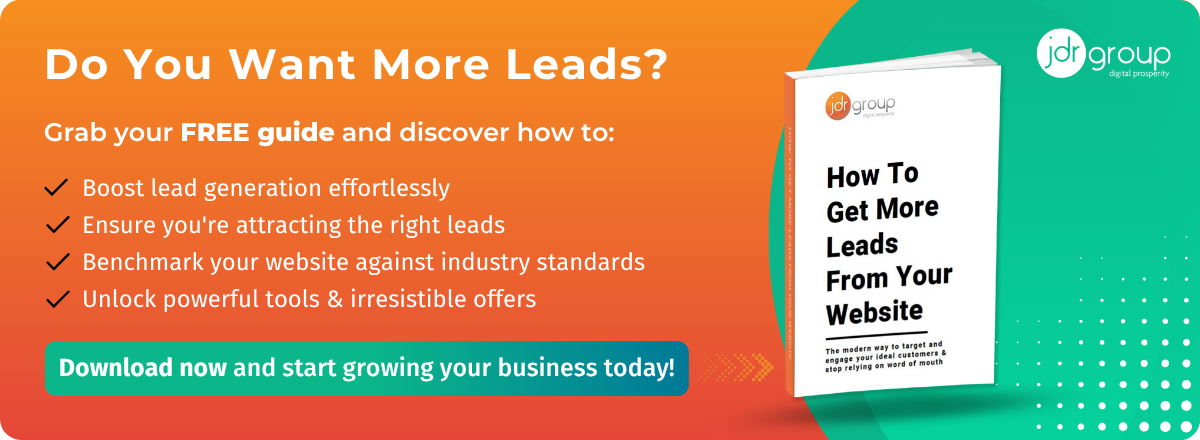
- Download our free guide: How to Get More Leads From Your Website. Discover practical steps you can take today to turn your website into a lead-generation machine.
Whichever step you choose, don’t put it off. Consistent leads mean consistent sales, and the sooner you put the right system in place, the sooner you’ll see results.
Is Your Website Just a “Brochure”? Here’s How to Turn It Into a Lead Machine
For many businesses, the website is little more than a digital brochure. It looks professional, it has a few pages about your services, and maybe a ne …
LinkedIn Algorithm Update 2026: What It Means For Your Content Strategy
LinkedIn has made a significant change to how content is ranked and shown in the feed. If you rely on LinkedIn to generate visibility, leads, and conv …

How To Generate Leads For Your Small Business - JDR Group’s Top 5 Tips
Many small business owners get frustrated when their companies don’t expand rapidly, but to make sustainable progress, you should be aiming for a stea …